
Nodal/Smad2 signaling sustains developmental pausing by repressing Pparg-mediated lipid metabolism
Authors: Giacomo Furlan, S. Bryn Martin, Brandon Cho, Ying Yu Ng, Sarah A. McClymont, Abdul Rahman, Elizabeth J. Robertson, Evelyne Collignon, Miguel Ramalho-Santos
Developmental Cell, 2026; doi: 10.1016/j.devcel.2026.07.006
PMID: 42551436
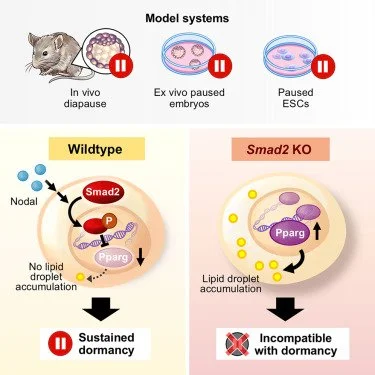
Abstract: Mammalian embryonic diapause is a reversible state of pre-implantation dormancy characterized by metabolic rewiring toward lipid usage as energy source. Whether active signaling sustains this dormant state remained unclear. Here, we show that the transforming growth factor- β (TGF-β) pathway, previously thought to only be required post-implantation, is essential for diapause. Nodal signaling is activated and its downstream effector SMAD family member 2 (Smad2) is required during diapause in vivo. Using ex vivo blastocyst and embryonic stem cells models of diapause, we show that Smad2 represses peroxisome proliferator-activated receptor gamma (Pparg), a master regulator of lipid storage. Loss of Smad2-mediated Pparg repression leads to lipid accumulation and is incompatible with pausing. Our findings establish a Nodal-Smad2-Pparg axis that is pivotal for sustaining the transcriptional and metabolic programs of embryonic diapause. This axis may be redeployed in other contexts, including cancer dormancy and metabolic disorders.